Thursday, October 27, 2016

Film Language: Cinematography

INCEPTION OPENING SEQUENCE

  The opening sequence I have chosen to analyse is from the critically acclaimed blockbuster 'inception' directed by Christopher Nolan. The sequence is set inside a dream where we meet our two protagonists and learn what they do. As it is a long opening sequence I will be analysing in depth the most noticeable and impactful shots.

The scene opens with a close up of what seems to be our protagonist, in a deprived state eating some sort of food, then it swiftly cuts to what seems to be the antagonist in this situation. The use of the exact same close up for both characters is effective as it creates enigma codes for the audience as they begin to ask why the protagonist was in that state in the first place and what connection the man in the second shot has to him. 

The over-the-shoulder shot of the protagonist from the antagonist angle may have been chosen to show that they are in a conversation with one another and it allows the audience to make a connection between the first shot and now. However, it does go on to create further questions as into why he is in this situation and looks different. Nolan has used this opening sequence to not only set the plot but to deepen the plot through creating a large amount of enigma codes. 

Using medium close ups throughout the conversation and cutting constantly between all three characters allows there to be a flow in the conversation. However, one thing that you can notice is that when there is a medium close up on the antagonist the camera movement is almost like a handheld one as there is a little bit of shake or zoom whereas with our two protagonists is a still medium close up shot. This may have been done to show us who has the upper hand in the conversation as it seems like the protagonists are trying to sell something or convince the antagonist of something. Another use of cinematography that the director uses to heighten the conversation is the use of the over-the-shoulder shot. It seems to only be used on behalf of the antagonist and when the protagonists are talking to him, this further highlights to the audience that the protagonists are almost against this character and are trying to get something across to him.

Towards the end of the conversation there is a lot of over-the-shoulder shots from the antagonist’s angle as it seems like the conversation is breaking down. As well as this the over-the-shoulder is no longer still but it begins to track the character it is focused on. Furthermore, the director begins to use handhelds on all the medium close ups till eventually the antagonist leaves the room. All of this was done to convey the idea that the conversation was breaking down towards the audience.

As the two protagonists are walking along the balcony and conversing the use of the over-shoulder-shots and eye-line between the two is convenient for the audience. But one of the protagonists points out that there is one of their love interests across the way and we can see from the camera that they are looking at something, this then makes the audience expect to see a shot of the love interest. However, the director does the opposite of this and has medium shot of the protagonist walking towards her. This is effective as it allows the audience to ask questions and creates enigma. 

When the protagonist and the love interest talk to one another there is an abundance of close ups and they are all constantly zooming in. This may be used to show their relationship for one another and how it is rapid and confusing and the use of these camera angles conveys this to the audience. The rapid cut into the bedroom and the audience seeing what the protagonist is doing raises a lot questions once again for the audience and when the protagonist starts to hang out of the window the camera angles are either tilt shots of crane shots but from someone viewing the protagonist perspective. This makes it more immersive for the audience as they feel like they are in the environment with the character.

In the scenes that contain action there is a significantly larger use of Steadicam and tracking shots. This may be done to show how spontaneity and constant the situation is and uncontrollable and to also add a flow to the scenes and make it more enjoyable for the audience.  

Wednesday, October 19, 2016

Film Language: Sound

                               A Clockwork Orange (1971)

The choice of music in this scene is very unexpected and contrapuntal. The audience usually connotes this type of classical music with peace and do to with the more sophisticated aspects of life. However, Kubrick has completely flipped this on its head and used it in a completely different context. He may have done this to make the audience feel uncomfortable and unaware of the events that are going to occur but to also highlight the insanity of the character who is doing the voice over as it seems like although the music is non-diegetic it is meant to be in the character's head. This goes onto further highlight the unusualness of the character and this situation. The director may have chosen this piece of music to go with scene to convey the characters feeling, as the connotations of this music piece is success and triumph which maybe how the character is feeling as he inflicting pain on his enemies. The use of increasing the volume of the music when the violence starts and putting it in slow motion may have been done to draw even more attention to the insanity and violence of the scene.

                        Once Upon A Time In The West (1968)

In this extract there is a large amount of different sounds mainly diegetic but all of them are heavily accentuated for the audience to hear. I think this is done to show the eeriness of the environment they are in that every little thing can be heard. To add to this this may have also been done to build tension as all of the sounds are simple everyday things but it seems like each character is waiting for something to happen and this creates enigma within the audience. Each sound for example the buzzing of the fly and the clicking of the fingers are all things that wouldn't be otherwise been heard unless they were deliberately increased in sound this has been done by the director to show how quite the place is. The sound bridge is near the end of the scene where the character who has caught the fly in the barrel of the gun all of a sudden hears the thundering of the train and his facial expression immediately changes. This affects the audience as they do not know what is happening as they cannot see the train yet but they do feel like this is what all the tension has been building up to once again creating more enigma codes within the audience.

                       Once Upon A Time In America (1984)

There was a wide array of sound in this extract including both diegetic and non-diegetic. There was more noticeable uses of diegetic sound such as the quiet background music at the beginning that appears to be playing outside the house, the rustling of newspaper, the voice of the man giving soup to the injured man, the fire, the fire hoses, the panicked voices of people, the clipping of the name tags on the dead men and the dialling of the phone. The main two uses of non-diegetic sound is the constant phone ringing and music being played at the funeral. The director uses the constant ringing to build the narrative starting from when we find out about the fire incident the audience may connect the phone call to that and that it could have been prevented if someone picked up the phone call. This question is then answered towards the end of the extract when we finally see someone dial a phone.


Monday, October 10, 2016

Learner Response i

WWW: Firstly, I’m impressed with how much you’ve managed to complete considering you’ve missed over a week of school – that’s a brilliant sign of commitment and independent working (crucial at A Level). The work you’ve done is very solid too – consistent use of media language (usually highlighted) which is vital to all written Media work. You’ve picked out some key aspects of the film posters and lighting stills and I really like the clips you’ve chosen for mise-en-scene. For film noir, your research is accurate and from a very reputable source but one of my EBIs will be to always write up research in your own words and also credit the source with a name or link.

EBI: You still need a bit more work to get fully up-to-date – the sound video and then following sound tasks. Let’s discuss these in the lesson on Monday and agree a realistic timescale to have everything complete. In terms of your work, keep an eye on your written English as it’s crucial you are communicating accurately at all times (you’ve confused there/their in a couple of places). Look over the lighting stills analysis as there is one example of high key lighting that you’ve picked out as low-key (the king top lit from above). For the Skyfall analysis, I think you could actually make a lot more of the mise-en-scene in terms of placing it as a Bond film – the exotic location (Istanbul I think?), the multiple fast-moving vehicles, the tuxedo etc. These offer a lot more than enigma – this is the Bond brand and exactly what audiences expect. Finally, your film noir research is largely (or entirely?) copied and pasted. We obviously expect research to come from the web but credit the website you used, use quotes if you’re copying it directly and always write up notes in your own words (you’re much more likely to remember the information if you do this too).


LR: Firstly, make sure you catch up with the missing work and discuss a realistic deadline with me. Then, for your LR, reflect on your first month of Film Language. What is your strongest piece of work so far? What is your weakest? What specific skills or knowledge do you need to develop over the rest of the course?

Saturday, October 8, 2016

Film Noir Research Task

                            FILM NOIR


What is Film Noir
Film Noir is Hollywood's only and oldest organic artistic movement that is today seen as an iconic genre.
When did Film Noir Start
Most dominant in the 1940s mostly after the second world war when audiences were looking for something fresh and vivid they responded well to this type of adult oriented film making it a success and continually allowed writers and directors who were eager to bring more adult themed films to Hollywood to do so.
Who brought about Film Noir
 Film Noir was heavily based around the Americans hard boiled crime fiction but was bought about by Europeans 'emigre' directors who's storytelling sensibility: highly stylized, overtly theatrical, with imagery often drawn from an earlier era of German “expressionist” cinema. Fritz Lang, Robert Siodmak, Billy Wilder, and Otto Preminger, among others, were among this Hollywood revolution.
 Few, if any of the artists in Hollywood who made these films called them “Noir” at the time.
Why is Film Noir so important to media community
Film Noir was most influential in a time of distress world wide and many felt they could relate to the dark senses of Film Noir. Furthermore, the vivid co-mingling of lost innocence, doomed romanticism, desperate desire, and shadowy sexuality that was unleashed in those immediate post-war years proved hugely influential, both among industry peers in the original era, and to future generation of Film lovers.

Below is an Extract of one of Film Noir most iconic movies; The Big Sleep

An adaptation from the hugely successful book by Raymond Chandler, it en-campuses all elements of Film Noir excellently. In this extract it is mainly about the portrayal of females and how certain things like  glasses can change the ideals of a woman.


SOURCE: http://www.filmnoirfoundation.org/filmnoir.html


Monday, September 26, 2016

Film Language: Lighting


                               Lighting

This still image mainly uses low key light as we can see a strong key light on the left side of her face and many shadows are created. The use of under lighting creates an effect of mystery and suspicion in the audience which is effective in this still as it seems to be a film noir.


The main lighting technique used in this still is high key lighting as the still is very realistic. The director may have chosen to use this technique as it seems to be an historical action film and they tried to make the film as realistic as possible for the audience. There seems to be some under lighting but overall the effect created by the lighting is gritty and realistic.


This still is a perfect example of top lighting. We can see this as the light has mainly been used to accentuate this actresses features. Furthermore the use of low key lighting to create hard and dramatic shadows creates the effect of horror but also passion from the look on the actresses face.


Overall this still has a very dark colour scheme, it seems to use back lighting and under lighting as harsh silhouettes have been created but the bottom of half of his face is heavily lit up. The effect of a dominant figure has been created by the shadows which connotes the film noir genre, however the lit buildings makes it a modern film noir. The most impressive part of this still is the fact that the rain has been lit up to the same standard as everything else adding depth and definition to the still.


This still seems to utilise both low key lighting and high key lighting. We can see a large hard shadow and almost a silhouette in a part of the image which suggests low key lighting and the rest is realistic natural light suggesting high key lighting. There seems to be a key light  coming from the side of the image but there is also a soft under lighting creating shadows. This creates the effect of danger and fear as the lady seems to be in imminent danger but the use of shadows creates the idea that she is afraid of someone or something.


In this still it seems like they are using low key lighting but then you notice the blinds are acting as natural light therefore making it high key lighting. However there is some light back lighting which increases the amount of shadows in the scene. The effect that the lack of lighting has is that there affection is private and just between the two of them but it could create some enigma codes as the audience may be wondering why they are being so secretive.


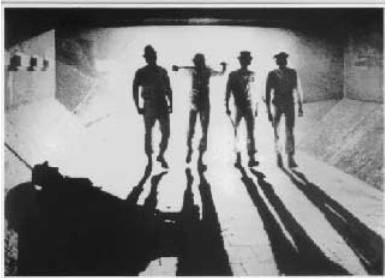
This still uses low key lighting to create an effect known as chiaroscuro. Where dramatic shadows are created using light and dark contrasts. The director of this has utilised this technique to give the silhouettes and there shadows some sort of character and personality individually. This has been done by using heavy back lighting to make the figures into silhouettes.


Low key lighting is used in this still to create fear and cause questions from the audience as to why the lady is so shocked. Another example of lighting being used to create enigma codes. The director has used under lighting and top lighting to accentuate the ladies features for the actor to convey her emotions to the audience. Creating an eerie and uncertain atmosphere which is what the director would be trying to portray in what seems to be this horror film genre.


A small amount of under lighting has been used in this still to create subtle shadows in what seems to be a still that has a strong amount of low key lighting. The use of soft light creates the ideal of peace and tranquillity which is a semiotic that is connected to the genre of drama or romance. 


The minimal amount of lighting creates the iconography of a horror film which audience can connote from the low key lighting. The lack of lighting creates the effect of uncertainty that the protagonist may be going through. The worm eyes view shot creates the idea that whoever's point we are viewing this from is hiding from the higher silhouette. The discreet use of back lighting also gives the figure an intimidating effect as it seems like it is stopping light from entering the room giving it a super natural feel.


The use top lighting to accentuate both actors features allows the audience to feel the affection of both love interests. The strong back light on the male connotes to the audience the way that the female sees him as her light and saviour. This is further highlighted by the use of low key lighting as it makes there love seem exaggerated and unrealistic. The darkness on the left side of the still where the danger is a use of enigma codes and semiotics as the audience automatically connotes the darkness and the gun with some sort of danger.

Wednesday, September 21, 2016

Film Language: Mise-en-scene

                 Still Image Analysis

Image result for the pursuit of happiness
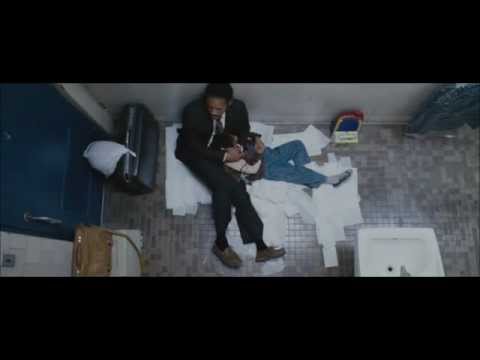
1)In this specific scene, the director has used a place of minimalism and added home like details to it. However, the costume of the two protagonists highlights to the audience that this place is not there home. This is done through the use of everyday clothing; the father is still in work clothes and the child is still in day clothes. This evokes emotion in audience as they can see the struggle that these two individuals are facing; however, the use of the actors lying down huddled together also shows to the audience that even in their time of struggle they have each other. The use of one central source of light, which is the bulb, creates a dull atmosphere in the scene. The director has done this not only to set the mood but to also allow the audience to feel what the characters are going through. The most important element of mis-en-scene that is utilised in this scene is the setting. The scene being set in a public toilet and the actors using it as a bedroom creates a theme of desperation and hard times which is conveyed to the audience, through the use of tissues on the floor. The use of the camera angle to capture the whole environment is even more effective as it further emphasises on what they are going through and highlights how small a place there in that they can catch it all on camera.


 2) The Shawshank Redemption (1994) (Drama)
 
The use of simple,average clothing shows to the audience that the characters are still adjusting to social norms being fresh out of prison and still looking for routine that they were so accustomed to. The constant increase in lighting throughout the scene, is used to highlight to the audience the constant increase in the characters mood as he finally reaches complete freedom. The actor has been placed in certain positions throughout the extract, to allow the camera to revolve around him,which may have been done to include the whole environment in the same way that the character is viewing his environment as he is fresh out of prison and everything is new to him. Making the revolving establishing shot effective in getting everything the audience needs to see on screen 


Skyfall (2012) (Action)

This extract is very minimalist on costume adding any elements to the mis-en-scene,except from when Bond leaps into the train and adjusts his expensive tuxedo. The use of Bond caring about his appearance and looking flawless during a time of chaos conveys what type of character he is and is essential to the bond franchise it is what makes James Bond...James Bond. Furthermore the use of a destroyed and chaotic background juxtaposed by the calmness of bond is effective in developing the scene. The use of warm colours to light scene, allows the audience to feel emerged in the exotic dessert location,this is also done through low key lighting to add realism to the environment. The placement of the three characters in the scene allows the director to get the most out of what is on screen. Bond being behind the antagonist and having obstacles around him creates enigma codes of how he will overcome these obstacles. The use of make up to add injury and damage in the scene is effective as it makes everything more realistic and evokes emotion in the audience as the protagonist they are rooting for is getting injured and may not complete the mission. All of this is effectively used to create the James Bond image, the fast paced scenes the tuxedo, the women this is all used on the camera to give the scene that authentic Bond identity that audiences expect. By using all his surrounding to his advantage even the use of an exotic country such as Istanbul, the director adds innovation to bond and more depth to the scene as many props have been utilised which will appeal to the audience of this film.


Zootopia (2016) (Family, Animation)

The diversity in this single extract is mainly because of the sheer amount of different designs and costumes and the use of personification of the animals, and them doing human like things. The use of high key lighting as we enter the city, conveys the feeling of paradise and utopia as the place almost feels surreal. Throughout the extract we see the city from the protagonists point of view and the placement of her throughout the scene allows us to see everything. At one point we have a shot which makes the audience and the character feel overwhelmed almost, this may have been done as everything including the main character has been captured in this shot. The sheer capacity of the setting in this scene makes it a excellent scene to have many strong aspects of mis-en-scene shown throughout the extract. With small details through each pan of the camera the director has made sure that the scene is constantly jam packed and fast paced to convey the feel of this bustling city to the audience.